

A few years after I bought my house, I purchased the vacant lot across the street and, with Grassroots Gardens, turned it into a community garden. Suddenly, all my free time went to digging, weeding, planting, and moving big rocks. By the end of the summer, my whole right hand hurt, especially my right thumb.
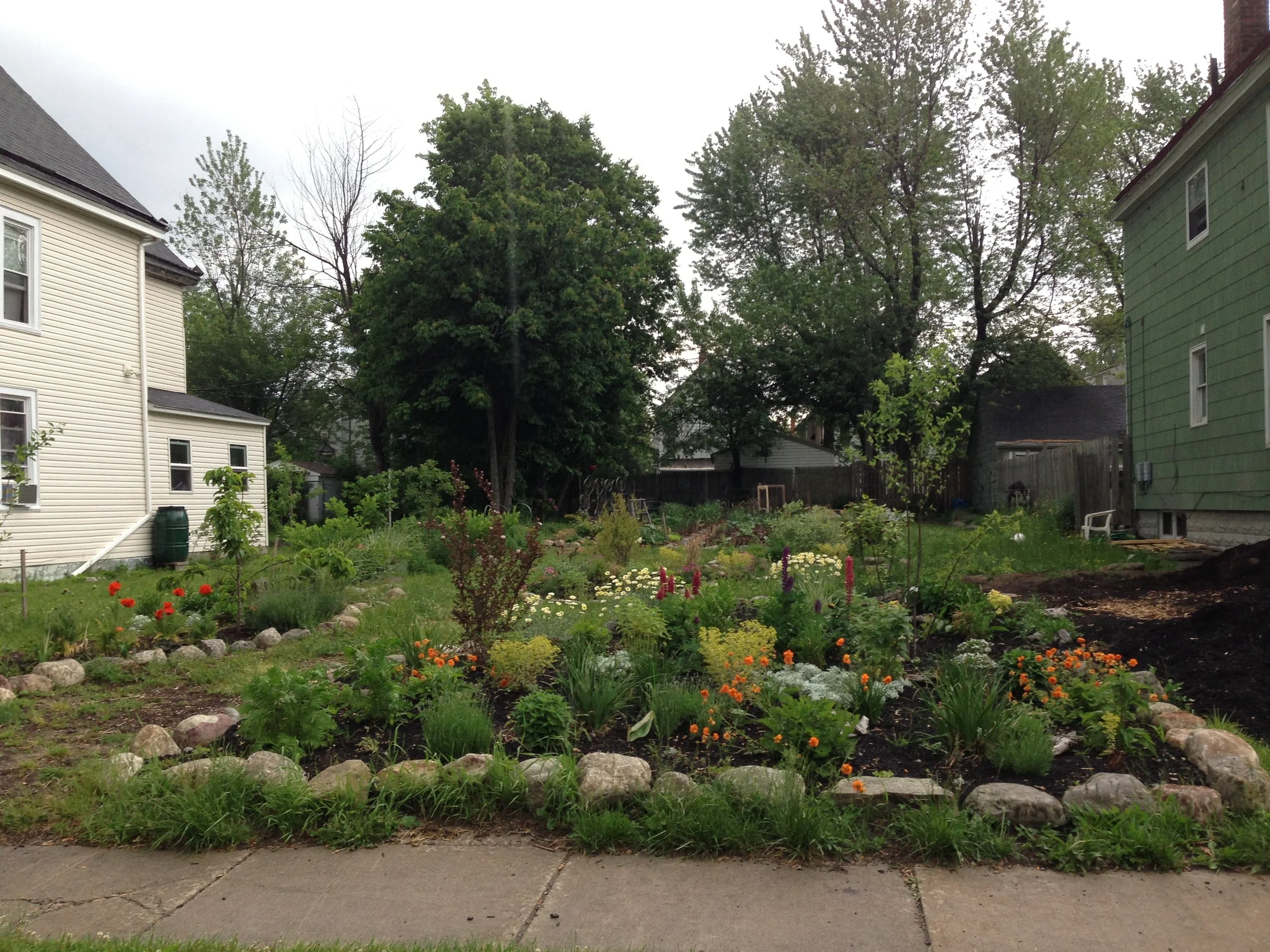
The garden in the early days.
At the same time, we were in the process of moving East Meets West Yoga Studio from the Elmwood Village to the Buffalo Foundry, which came with a renovation and endless decisions about layout, design, and colors.
Simultaneously, because nothing can be easy, I was having my kitchen renovated: almost six months of work, including a moved window, new plumbing, a half bath, a new door, and a back deck, plus weeks without a working kitchen.
My hand and thumb were so painful that it was impossible to practice and incredibly hard to teach. I went to a physical therapist, because that's what you do when you're in pain.
Unfortunately, the sessions made it worse. After 10 sessions, my whole right side was in pain. My sleep was affected. My teaching was affected. It seemed like it would never be better.
Then we finished the move. The day after we were out of the old space, the pain had eased enough to be bearable. For the most part, it was just a normal day. I woke up, started moving around, and realized I could do my daily activities with relative ease, when the day before I could barely move that side of my body. I was stunned. Certainly happy, but also a little confused.
(A massage therapist using gentle methods helped too, and he introduced me to isometrics and eccentrics. More on that below.)
What the Pain Bucket Is
The Pain Bucket is a metaphor. I learned it from Greg Lehman, a physical therapist and pain educator, during my 300-hour training with Jules Mitchell. The idea originally comes from the mental health world, where it's called the "stress bucket," but it fits pain beautifully. When I heard it, it was a light bulb moment: Oh, that's what happened.
It comes from the bio-psycho-social model of pain. There are all of these other things happening in a person's life that can affect what we feel in our bodies. A really bad night of sleep, or several. Stress at home or at work. Financial concerns. Global anxieties. All of these things add up, and they fill the bucket.
I'm Not Saying It's All in Your Head
When I bring up the bio-psycho-social model in a room, people sometimes hear it as me saying they're imagining it. I'm not saying it's all in your head. Your pain is real. I'm saying that more than one thing is feeding it.
This Is Temporary
How you drain your bucket is up to you, and what works for one person may not work for another. For me, the most important thing is remembering that pain has many factors. That alone helps me manage what I'm feeling.
When I feel something flare up, I tell myself: This is temporary. It decreases my fear and anxiety, and I don't start spiraling through What am I going to do? How am I going to handle this?
A few months ago, I hurt my knee demonstrating something in class (some of you read about it). I woke up the next day in a lot of pain, with a canoe trip coming up that involved multiple portages and carrying a lot of gear. In the past, I would have panicked. This time I talked myself down: I can handle this. This is temporary. I knew I had techniques to help myself, and I didn't let myself get scared.
By the time the trip rolled around, the pain was gone.
Words Matter
You've probably heard of the placebo effect, where believing something will help can actually make you feel better. Its lesser-known opposite is the nocebo effect, where fearful expectations can increase pain and slow recovery. Sometimes doctors and other providers use language that sounds scary, like "degeneration" or "tendinopathy," or they tell you to avoid certain movements. A diagnosis can sound alarming just because it has a special name. "Tendinopathy," for example, is simply a broad term for a painful, irritated tendon. It's common, and it usually responds well to gradual loading. Your providers want you to get better, and it's okay to ask them what a word or diagnosis really means for your daily life.
Rest Can Help, but It's Not a Long-Term Solution
Rest can be helpful, especially in a flare, but it's a temporary solution. Research increasingly supports staying active. For low back pain, for example, advice to stay active works better than bed rest, and major guidelines now recommend gentle movement over rest.
Progressive loading, which means gradually asking your body to do a bit more, can actually help decrease pain:
Isometrics (holding a contraction without moving) have been shown to reduce pain in some people, sometimes right away.
Eccentrics (slow, controlled lowering) have a long history of helping with tendon pain, like Achilles and tennis elbow.
Newer research shows heavy, slow strength training works just as well. So the real magic isn't one type of contraction. It's gradual, consistent loading.
How This Shows Up at New Moon
When someone tells me they're in pain, whether they reach out ahead of time or walk into class with it, my first step is to turn down the temperature to decrease their fear. I ask questions about what they're experiencing, but my goal is for them to feel confident that we can address it so they feel better.
In Mindful Strength Training, when we get to an exercise for the area that's bothering someone, we may start with isometrics to help relieve the pain, then add eccentrics to help the brain reconnect with that part of the body. From there, we may or may not return to progressive loading for that exercise.
In Soft Strength℠, everyone is doing the same thing at the same time, so I weave in pieces for the whole group. If someone comes in and says their neck is bothering them because they slept poorly, we might start class on our backs with some somatic movement for the head, neck, and shoulders, plus some nerve flossing to bring different kinds of sensation into that area. In the more active part of class, we'll add isometrics and eccentrics for that part of the body. Throughout, I use positive language so they can feel a little more comfortable with that part of their body. Then we end class with somatic movement again.
When your bucket is full, Muscle Mending℠ and Restorative Yoga are great places to land. Both give your nervous system slow, safe, low-demand time to settle. Each class is entirely on the floor and supported. In Muscle Mending℠, we focus on slow, intentional movements to help with coordination and to find movements that can decrease pain. In Restorative Yoga, we rest in supported positions that are designed to help stretch, open, and lengthen.
If you remember one thing: pain is a message, not a verdict. It doesn't necessarily mean injury, and it doesn't mean you have to stop moving.